


Liber School
Background
In 1986, our school was initiated by members of the community of Damanhur, one of the oldest intentional communities in Europe. Since then, LiberSchool has grown and is attended by 80 children from Nursery to Middle School (0–14), half of them children from families of the community of Damanhur, and half from families of the surrounding area. It was motivated by the desire to support the harmonious spiritual and cultural development of children.
We function as a parental school within Italian law, where homeschooling is a constitutional right. We are 100% self-funded and rely on donations from our supporting network, tuition fees, and voluntary work.
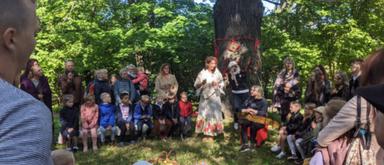
Our learning spaces are located in a stimulating landscape of rocks and trees in the “Monti Pelati” nature park. We have both outdoor classrooms and indoor facilities. Thanks to two minibuses, we travel across Italy and Europe, turning the historical, artistic, and natural locations we visit into true itinerant classrooms.


One course. Four dimensions. Unlimited impact.
Vision
LiberSchool nurtures the full development of every child—emotionally, intellectually, spiritually, and socially. Rooted in cooperation, ecological awareness, and inner growth, it aims to accompany children in discovering their unique potential and making a meaningful contribution to the world.
Mission
Our mission is to inspire autonomy, responsibility, joy in learning, and connection with self, others, and nature. We envision a future led by conscious individuals who embrace collaboration and sustainability in all forms of life.
Vision
Gaia School is a learning environment grounded in the principles of Gaia Education — promoting a sustainable lifestyle and care for both the Earth and people. It supports students’ ability to develop excellent collaboration skills, live according to sustainable values, and take responsibility for themselves and the world around them.
The vision of Gaia School can be summed up with the motto: Healthy People, Healthy Community, Healthy World!
Mission
Gaia School values the individual needs of each student. The school focuses on nature studies and cultural heritage, which help integrate different subjects and provide a holistic learning experience.
Values
Gaia School’s value system is based on the principles of harmonious coexistence between humans and nature. The school is named after the planet Earth — Gaia is the Greek name for Earth. The core values of Gaia School include love, awareness, joy, trust, freedom, openness, connection, co-creation, experience, and abundance.
These values are organized according to the four main areas of the Gaia Education program: worldview, economic, ecological, and social. Accordingly, the school is founded on four basic values, which are outlined as follows:
Worldview — the value is collaboration.
Economy — the value is the courage to lead change.
Ecology — the value is sustainability.
Social — the value is supporting individuality.
Pedagogy, Methodology, Approach
LiberSchool’s approach is personalized and experiential. Learning is active and rooted in real-life contexts. We appreciate cultural diversity and consider different needs, styles, and learning paces as valuable elements for mutual enrichment.
A characteristic of our school has always been the presence of children with at least one parent who is not a native Italian speaker.
LiberSchool exemplifies these principles by creating a personalized and experiential learning environment, nurturing critical thinking skills, and aiming to develop students who become future leaders of innovative change.
Core Educational Tools
Group-based social learning
Immersion in nature
A dynamic, stimulating school environment
Experiential pedagogy and outdoor lessons
Mobility and itinerant learning
Artistic and manual expression
Embodied learning through movement and play
Connection with Gaia Education
As a Gaia School, LiberSchool applies the Education Mandala—social, economic, ecological, and worldview dimensions— as core framework both through our curriculum and in the way we run our school.


How is the EDE Curriculum / 4D Applied in Daily Activities?
At Gaia School, the EDE (Ecovillage Design Education) Curriculum and its Four Dimensions — Social, Ecological, Economic, and Worldview — are embedded in our daily learning and school culture. These dimensions are not taught as separate subjects but are interwoven into all activities, creating a holistic and meaningful learning experience.


Worldview
Attitude of awe and communication with nature and invisible realms. Outdoor pedagogy using the school park and nearby forest and mountain, “music of the plants” experiences, each child has a “tree friend.” Contact with elements as living beings.
Highlight: Itinerant learning journeys across Italy and Europe using dedicated minibuses to visit the world and learn on site. Rich intercultural exchange due to families from diverse backgrounds
Challenges: Navigating state education requirements within an alternative model
Ecological
Daily life is integrated with nature—lessons are held outdoors, and the natural landscape is a co-teacher. Observation and understanding of local forest ecosystems and wildlife.
Examples: Use of solar-powered spots in school spaces, use of filtered, pure drinking water to avoid waste, School lunch is zero-km and based on local organic produce, Thermal insulation of attic and walls using cellulose fiber
Highlight: Strong integration of natural learning environments
Social
Art and community are key denominators: Learning to observe and listen, to share one’s thoughts and accept one’s limits, to bring oneself into the world consciously—with courage and the ability to discern through critical and lateral thinking—in order to make choices that are not influenced by external factors but are intentional. Learning to recognize one’s own thoughts and emotions teaches how to navigate life and make choices that are coherent and satisfying in relation to oneself.
Examples: Weekly circles for dialogue, nonviolent and empathic communication. Pupils co-create decisions by integrating visions and proposals. Rotating elected roles: class captain, cleanliness, planet friend, rituals, librarian, fire guardian, safety, etc. Pupils take turns for mealtime setup and cleanup, and daily classroom organization. Welcome of psychological and cultural diversity, support for special needs. Parental involvement through representatives, volunteer work, after-school.
Highlight: the vicinity of Damanhur community is an incredible resource to be inspired by testimonials from foreign guests, exposure to art…
Challenges: involve all parents.
Economic
The school is 100% self-funded for 40 years thanks to value of community solidarity. A combination of sustainable tuition fees, donations, and volunteer work is the key. Time bank and volunteer hours used as alternative currency to support school activities and parents with less access to euros. Internships of students in local businesses. Children fundraise for trips and activities.
Challenge: Sustaining financial independence
Highlights: Self-managed school model promotes autonomy and innovation


Short Story about Local Impact
LiberSchool plays a vital role in the cultural and educational landscape of the Piedmont region. Its presence strengthens ties between the intentional community of Damanhur and local families, offering an inclusive, nature-based alternative to mainstream schooling. The school’s engagement in the local economy and community events has made it a well-regarded center of innovative education.
Testimonials, Stories, Quo
“I can say that this is a school that aims to accompany children through that delicate process that is the search for the self, thanks to teachers who are very clear that they are dealing with spiritual beings and not as vessels to be filled.”
(a parent)
I attended Damanhur Family School from the very early years until I was 14. I am grateful to have taken this path because it has allowed me to be the person I am now.
(former student and you parent)
what had the strongest impact on me: theory was always combined with life experiences to learn together and discover new parts of ourselves and others, such as using all the space and contexts around us. [...] To this day, I still use the tools I acquired then to guide my path.
(former student)
“I can say that this is a school that aims to accompany children through that delicate process that is the search for the self, thanks to teachers who are very clear that they are dealing with spiritual beings and not as vessels to be filled.”
(a parent)
Knowing how to manage relationships differently, autonomy, the ability to understand how a group works and to manage and be part of a group, the ability to dream, to see that nothing is impossible—you just need to want it. This is what I would also like to convey to the kids.
(Teacher and former student)
what had the strongest impact on me: theory was always combined with life experiences to learn together and discover new parts of ourselves and others, such as using all the space and contexts around us. [...] To this day, I still use the tools I acquired then to guide my path.
(former student)
Economic Framework
LiberSchool functions as a parental school under Italian law. It is entirely self-funded through:
Tuition fees
Donations from a supportive community network
Voluntary contributions of time and skills



School Website and other links
Know more about Liber School visiting it’s online material


Energy Systems Course Format and Details
Course format:
Online, flexible modules
Price:
200 GBP
Limited number of partial scholarship available, apply here by 15 Feb 2026
Duration:
5 weeks
Workload:
Approximately 5 hours per week
Structure:
Live sessions, Forums and complimentary material
Live Sessions
Four 2,5 hours interactive sessions with Curtis Ogden
Have questions? We’ve got answers.
No previous experience is required. All you need is a passion for community building and collaboration.
The course is designed to fit busy schedules with around 10 hours per week of flexible study. Though highly encouraged, Live Sessions are not mandatory and are recorded to be watched later.
Yes! The course provides hands-on tools you can apply immediately in your community.
An energy systems course explores how energy flows through living, social, and economic systems, and how these flows shape resilience, equity, and long-term sustainability.
No. This course is accessible and experiential, combining systems science with practical tools and real-world applications.
Entirely online with live sessions, group discussions, and self-paced assignments. You’ll have access to experienced facilitators, a supportive learning community, and rich resource materials.
Yes. The course is designed for people working in community development, sustainability, education, social innovation, and regenerative design.
Participants have life-long access to the course material. Though the course has a defined length, participants can go back to the material any time after the course completion.
Have questions? We’ve got answers.
An energy systems course explores how energy flows through living, social, and economic systems, and how these flows shape resilience, equity, and long-term sustainability.
No. This course is accessible and experiential, combining systems science with practical tools and real-world applications.
Entirely online with live sessions, group discussions, and self-paced assignments. You’ll have access to experienced facilitators, a supportive learning community, and rich resource materials.
Yes. The course is designed for people working in community development, sustainability, education, social innovation, and regenerative design.
Participants have life-long access to the course material. Though the course has a defined length, participants can go back to the material any time after the course completion.
An energy systems course explores how energy flows through living, social, and economic systems, and how these flows shape resilience, equity, and long-term sustainability.
No. This course is accessible and experiential, combining systems science with practical tools and real-world applications.
Entirely online with live sessions, group discussions, and self-paced assignments. You’ll have access to experienced facilitators, a supportive learning community, and rich resource materials.
Yes. The course is designed for people working in community development, sustainability, education, social innovation, and regenerative design.
Participants have life-long access to the course material. Though the course has a defined length, participants can go back to the material any time after the course completion.
An energy systems course explores how energy flows through living, social, and economic systems, and how these flows shape resilience, equity, and long-term sustainability.
No. This course is accessible and experiential, combining systems science with practical tools and real-world applications.
Entirely online with live sessions, group discussions, and self-paced assignments. You’ll have access to experienced facilitators, a supportive learning community, and rich resource materials.
Yes. The course is designed for people working in community development, sustainability, education, social innovation, and regenerative design.
Participants have life-long access to the course material. Though the course has a defined length, participants can go back to the material any time after the course completion.



Education is a key driver in co-creating a regenerative future.
Grow your understanding of energy flows and systems design. Be part of building a more just, regenerative, and sustainable future.
Secure your place today and start your transformative journey!

Speak with us on WhatsApp!