


A transformative journey into the heart of community building.
A transformative journey into the heart of community building.
Join a rare opportunity to participate in a full Ecovillage Design Education (EDE) online and LIVE, led by top facilitators and experts from around the globe.


Empowering individuals to design and implement sustainable and regenerative lifestyles, organisations, and systems.
This LIVE, four-month course is a transformative journey into the heart of community building, collaborative learning, design for sustainability and regeneration, offering the tools, skills, and inspiration needed to co-create thriving, resilient communities and projects.
You’ll be guided by experienced EDE trainers Taisa Mattos and Macaco Tamerice, and joined by an inspiring lineup of guest educators including:
Daniel Christian Wahl, Helena Norberg-Hodge, John Croft, Albert Bates, Kosha Joubert, Daniel Greenberg, Jonathan Dawson, Ina Meyer-Stoll, Achim Ecker, Anna Kovasna, André Soares, Tomaz Lotufo, and Mugove Nyika.


Why Join?
More than a Course
EDEs are known to be life-changing experiences. Participants from all walks of life have gone on to become facilitators, community leaders, regenerative entrepreneurs, and change-makers in their local and global contexts, as well as leading more meaningful, joyful and healthier lives.
Whether you're working in education, urban development, community development, sustainability, social entrepreneurship or personal transformation, this course will provide practical tools, frameworks, and inspiration to support your journey.
Skills Gained
Practical skills to co-create sustainable projects and communities
Frameworks to design for regeneration and resilience
Tools for group facilitation and collaborative leadership
Connections with a global network of changemakers
Confidence to step into the role of facilitator, educator, or ecovillage designer
This is more than a course, it's a transformative learning journey!

About the EDE
The Ecovillage Design Education (EDE) program emerged over two decades ago from the lived experience of ecovillages and cutting edge educators in order to share how to create new ways of living with low environmental impact, low consumption and high quality of life. Built on the foundation of transformative, participatory education, the EDE empowers individuals to design and implement sustainable and regenerative lifestyles, organisations, and systems.
The curriculum weaves together four key dimensions of sustainability:
Social – strengthening collaboration and community resilience
Ecological – designing and restoring ecosystems to create resilience and minimum environmental impact
Economic – fostering circular, regenerative and inclusive economies
Worldview (Cultural) – cultivating inner transformation, shared values, and living in harmony with nature
How You’ll learn
The programme explores the four areas of regeneration: Social, Ecological, Economic, and Worldview, through a rich blend of:
Live presentations and expert talks
Q&A sessions with guest speakers
Presentations and interactive exercises
Group dynamics, deep sharing, and participatory activities
Project design sessions, where you will create and co-develop regenerative initiatives along wit your peers and facilitators

Social
Enhance your leadership and collaboration skills with practical tools to empower communities, advance social justice, create inclusive solutions, and implement effective governance strategies.
Starts: 6 October 2025
Ecological
Master regenerative design and ecological practices to restore nature, applying principles of permaculture, ecosystem resilience, and innovative environmental solutions.
Starts: 12 January 2026
Economic
Develop regenerative economic models by integrating local economies, ethical finance, conscious consumption, and systems that foster prosperity without depleting natural resources.
Starts: 25 May 2026
Worldview
Expand your perspective by embracing holistic values, ecological ethics, and transformative spirituality while balancing innovation with ancestral wisdom.
Starts: 23 March 2026

Is the Online EDE for You?
The Ecovillage Design Education is for you if you want to:
Gain confidence in participatory facilitation and building resilient learning communities
Improve your communication skills and conflict facilitation skills
Explore shared leadership and participatory decision making
Practice deep sharing & trust building
Learn about appropriate environmental technologies
Identify how to support and strengthen local economies
Understand how to think globally and act locally
Gain a holistic perspective of sustainability and community building
Learn from the real experience of community builders and ecovillage founders from around the world
Strengthen your design and implementation skills for regenerative projects
Collaborate with others to co-develop your own project or dream throughout the course
Course details
Course format:
Online, LIVE course
Price:
Early Bird: 800 GBP
Regular: 900 GBP
Abundant: 1000 GBP
Scholarship 500 GBP (Youth and Global South. Application needed.)
Dates:
from March 7th to July 11th
Duration:
4 months
Structure:
LIVE calls with facilitators and guest teachers every Saturday at 14.00 –17.00 UTC and on Sunday June 28th. (Find your local time here)
Weekly project design group meetings to be decided by each working group.
Facilitation:
Wide variety of renowned Guest Teachers and experienced facilitators
Certificate:
Certification upon completion of the full course
Certified by Gaia Education. Co-certified by GEN.
Guided by experts in social transformation.
The GEDS Full Course is guided by dedicated professionals with real-world experience across all dimensions of sustainability.
Meet some of our facilitators:


Aline Van Moerbeke
Flemish born but residing in Spain since 2000, where she arrived as a Chinese Philologies' student working a summer job as an entertainer, and then ended up again for love. Just over a decade later she finds herself taking the Ecological Dimension of a Gaia EDE course on Mallorca, where she learns about whole systems design, bioconstruction, and... permaculture.

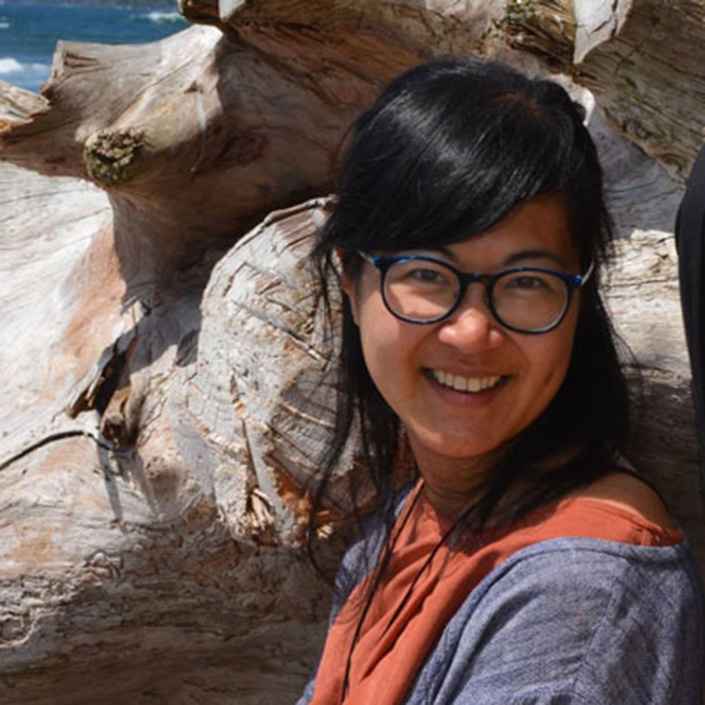
Gracelynn Lau
Self-identified as a settler of colour born and raised in British Hong Kong, Gracelynn Lau is a nature-based expressive arts therapist and community facilitator based in Canada. In 2005 Gracelynn began her master degree in worldview studies specializing in ecofeminist theology. The studies brought her to an inquiry into faith, ecological and personal healing.

Root Cuthbertson
Growing up between Montreal, New Hampshire, and Boston, Root learned to love dancing, music, poetry, public libraries, matching needs with resources, monofloral honeys, generously inclusive humor, and stories about healing and hope.
Learn from Global Sustainability Experts
The Online EDE Course is guided by dedicated professionals with real-world experience across all dimensions of sustainability.
Core Team:

Taisa Mattos
Gaia Schools Coordinator, is an experienced Gaia Education certified trainer. She has coordinated and taught Ecovillage Design Education Programmes since 2009, having contributed to over 30 programmes so far, all over Brazil, also in Portugal, Argentina, Mexico, Mozambique and online. Taisa works as an international trainer and consultant in the fields of sustainability, regenerative education and community life.
Taisa has served as the Global Ecovillage Network - GEN Education and Research Coordinator from 2019 to 2024. Lead author of the GEN Regenerative Urban Communities Manual.
Ecovillage researcher and Board member of the International Communal Studies Association (ICSA), Taisa is the author of the book Ecovillages: building a regenerative culture. She holds a masters degree in Communities and Social Ecology.
Taisa has contributed to transition initiatives both in urban and rural areas, being the co-founder of Terra Una Ecovillage (Brazil) and other small urban communities in Rio. She has been actively engaged with the Ecovillage Movement since 2004.

Macaco Tamerice
Macaco Tamerice is a sociologist, a life coach for meaningful relationships specialized in trauma work, inner transformation, community-building, leadership, and conflict resolution.
She has been living at Damanhur, Federation of Communities, since 1993, where she has held many roles of social and artistic responsibility, including serving as a Guide of the Federation.
In 2008, she became Vice President and later President of the Global Ecovillage Network-Europe (GEN Europe) until 2015. She now serves on GEN’s Network Steward Circle, as one of GEN’s UN representatives, and as President of the NGO Damanhur Education.
In recent years, she has deepened her expertise in trauma work, studying extensively and earning certifications from renowned experts such as Gabor Maté, Richard Schwartz, Thomas Hübl, Bessel van der Kolk, Stephen Porges, Peter Levine, and others.
Macaco is an international speaker, facilitator, Gaia Education’s face-to-face programmes consultant and certification manager, and a certified GEESE Educator (Global Ecovillage Educators for a Sustainable Earth). She has taught over 20 EDEs and several ToTs in various countries.
Trained in music and voice, she toured as a professional jazz singer in Europe, Canada, and Japan for over twenty years and has taught voice and led classes and seminars since 1984.
Guest Trainers:


Ina Meyer-Stoll
has been part of ZEGG and its forerunner communities since 1984. She was one of the founding members of the ecovillage ZEGG. 6 years executive secretary of GEN-Europe, (www.gen-europe.org). Since 2004, Ina has been involved in Gaia Education (www.gaiaeducation.org).
Communications trainer and supervisor for 30 years, specializing in building community, creating transparency and trust in group processes.


Albert Bates
influential figure in the intentional community and ecovillage movements. He has been a resident of The Farm since 1972, and co-founded the Ecovillage Network of the Americas and the Global Ecovillage Network. He is a retired public interest attorney and author of more than a dozen books on energy, environment and history.
Albert’s books Shutdown: Nuclear Power on Trial (1979) and Climate in Crisis (1990) provided early insight into two of the greatest dangers now confronting the world. In 1980 he shared the first Right Livelihood Award for his work with Plenty International in preserving indigenous cultures. He was designer of concentrating photovoltaic arrays and solar-hybrid automobiles displayed at the 1982 World’s Fair.
Albert has been director of the Global Village Institute for Appropriate Technology since 1984 and of the Ecovillage Training Center at The Farm community since 1994. Many of his books are available on Amazon, most recently Pour Evian on Your Radishes (2014) and The Paris Agreement (2015).

Achim Ecker
has been part of ZEGG and its forerunner communities since 1984. He has been ZEGG's chief landscape designer since 1991 creating fertile soil and an edible landscape and forest. He is also an eco builder retrofitting and insulating existing houses with renewable materials. As a social worker he has been deeply involved in the development of the ZEGG-Forum and has trained and supervised groups at ZEGG and in Europe, South America and the USA.

André Soares
trilingual permaculture designer/teacher and natural builder, and since 1994 has trained more than 7 thousand designers in Brazil, Portugal, Australia and the USA.
Co-founder of The Permaculture Institute of Central Queensland and NAG community radio in Australia and Ecocentro Ipec in Central Brazil, a living and learning ecovillage centre that has seeded the Permaculture and Natural building movement in many regions of South America.
Andre has received multiple design awards for his work with Ecovila Santa Branca and Boom Festival, a biannual gathering of 50,000 people in Portugal. Andre was the first representative of GEN in Latin America in 1998 and has been recognised since as Social Entrepreneur in three continents.

Tomaz Lotufo
He holds a degree in Architecture and Urbanism from the Pontifical Catholic University of Campinas (2000) and a master's degree in Architecture and Urbanism from the University of São Paulo (2014).
He is currently a postgraduate professor at the Belas Artes University Center in São Paulo, an architect at Sem Muros Arquitetura Integrada, and an architect and permaculture practitioner with the Permear Permaculture Network. He has experience in the field of Architecture and Urbanism, with an emphasis on sustainable architecture, and works mainly on the following topics: permaculture, sustainable architecture, sustainable construction, participatory design, and architectural education.


Jonathan Dawson
is a sustainability educator, currently working as Head of Economics at Schumacher College in Devon. Until recently a long-term resident at the Findhorn ecovillage and a former President of the Global Ecovillage Network, he has around 20 years experience as a researcher, author, consultant and project manager in the field of small enterprise development in Africa and South Asia.
Jonathan is part of the team that created the Gaia Education sustainable economy curriculum, drawn from best practice within ecovillages worldwide, that has been endorsed by UNITAR and adopted by UNESCO as a valuable contribution to the UN Decade of Education for Sustainable Development.

Gaia Education Learning Journey
How to Become a Certified Trainer
The Ecovillage Design Education (EDE) program is the oldest and most well-known educational offering in the global ecovillage movement.
Now over 20 years old, it remains remarkably cutting-edge, continuing to evolve and inspire. The EDE has transformed the lives of people of all ages, across every continent.
Participating in an EDE is a key step in completing the Gaia Education Learning Journey and becoming a certified Gaia Education trainer.
While the EDE is offered around the world in various in-person formats through our global network of partners, we recognize that not everyone can attend a month-long immersive course, or it may not yet be available in your region.
That’s why this Online EDE is such a unique and valuable opportunity to join the experience from wherever you are.
Gaia Education
Learning Journey

Taking the EDE is a crucial part of the Gaia Education learning journey and brings you one step closer to becoming a certified trainer.
Know more about the Certified Trainers Programme:
Social
Enhance your leadership and collaboration skills with practical tools to empower communities, advance social justice, create inclusive solutions, and implement effective governance strategies.
Starts: 6 October 2025
Ecological
Master regenerative design and ecological practices to restore nature, applying principles of permaculture, ecosystem resilience, and innovative environmental solutions.
Starts: 12 January 2026
Economic
Develop regenerative economic models by integrating local economies, ethical finance, conscious consumption, and systems that foster prosperity without depleting natural resources.
Starts: 25 May 2026
Worldview
Expand your perspective by embracing holistic values, ecological ethics, and transformative spirituality while balancing innovation with ancestral wisdom.
Starts: 23 March 2026
What Our Learners Say.

I realize I am more capable than I had assumed. I am grateful for the learning format to facilitate speedy learning. Our project planning now includes more depth and detailing thanks to this course."
– K. U. S.
The course content was very comprehensive, detailed and practical. I appreciated how the facilitators brought a focus on real-world applications from the very beginning. They both modelled the principles of harmonious and supportive group-working that we were learning."
– N. B.
Freedom and flexibility. Meaningful content. Great facilitation.
Inspirational and diverse group of other students.
Loved the mix of self study and live sessions."
– E. C.
Have questions? We’ve got answers.
No previous experience is required. All you need is a passion for community building and collaboration.
The course is designed to fit busy schedules with around 10 hours per week of flexible study. Though highly encouraged, Live Sessions are not mandatory and are recorded to be watched later.
Yes! The course provides hands-on tools you can apply immediately in your community.
A comprehensive programme covering four dimensions of sustainability: social, ecological, economic, and worldview.
No prior experience is required. This course is designed for both beginners and advanced learners. Whether you’re new to sustainability or looking to deepen your expertise, the course provides accessible and actionable content for everyone.
Entirely online with live sessions, group discussions, and self-paced assignments. You’ll have access to experienced facilitators, a supportive learning community, and rich resource materials.
Yes, each dimension can be taken as a standalone course, so if you are interested in specific dimensions, you can take them separately. Enrolling in the full course provides a holistic understanding of sustainability and is more cost-effective.
The Design Studio is the integration piece of the GEDS Full programme that you can join after complete the 4 Dimensions.
Participants have life-long access to the course material. Though the course has a defined length, participants can go back to the material any time after the course completion.
Have questions? We’ve got answers.
A comprehensive programme covering four dimensions of sustainability: social, ecological, economic, and worldview.
No prior experience is required. This course is designed for both beginners and advanced learners. Whether you’re new to sustainability or looking to deepen your expertise, the course provides accessible and actionable content for everyone.
Entirely online with live sessions, group discussions, and self-paced assignments. You’ll have access to experienced facilitators, a supportive learning community, and rich resource materials.
Yes, each dimension can be taken as a standalone course, so if you are interested in specific dimensions, you can take them separately. Enrolling in the full course provides a holistic understanding of sustainability and is more cost-effective.
The Design Studio is the integration piece of the GEDS Full programme that you can join after complete the 4 Dimensions.
Participants have life-long access to the course material. Though the course has a defined length, participants can go back to the material any time after the course completion.
A comprehensive programme covering four dimensions of sustainability: social, ecological, economic, and worldview.
No prior experience is required. This course is designed for both beginners and advanced learners. Whether you’re new to sustainability or looking to deepen your expertise, the course provides accessible and actionable content for everyone.
Entirely online with live sessions, group discussions, and self-paced assignments. You’ll have access to experienced facilitators, a supportive learning community, and rich resource materials.
Yes, each dimension can be taken as a standalone course, so if you are interested in specific dimensions, you can take them separately. Enrolling in the full course provides a holistic understanding of sustainability and is more cost-effective.
The Design Studio is the integration piece of the GEDS Full programme that you can join after complete the 4 Dimensions.
Participants have life-long access to the course material. Though the course has a defined length, participants can go back to the material any time after the course completion.



Take your next step toward a Sustainable Future.
Be part of a global community of sustainability leaders. Secure your place today and start your transformative journey!


Speak with us on Whatsapp!