

Weaving Resilience: A Proven Journey into Community Strength in Times of Polycrisis

What does it really take for communities to thrive in a world that is constantly shaken by current climate crisis, social inequality, instabilities and much more?
After a powerful pilot which you can read more about below, with 20 ecovillages across five continents, Weaving Resilience is now opening as an online course starting 13th April 2026— inviting a new wave of communities, leaders, and change-makers to deepen their capacity to navigate climate change and the polycrisis with courage, clarity, and connection.
This is not just another climate course. It is a lived, research-based, community-rooted process developed in collaboration with the Global Ecovillage Network and its regional networks — GEN Oceania & Asia, GEN Africa, GEN Europe, CASA Latina, and GEN North America.
GEN has decades of experience working with ecovillages around the world and seeing first hand how communities can thrive in very different ecosystems, set of beliefs and different governmental contexts.
A Global Community of Practice
From September 2022 to May 2024, 1–3 representatives from each of twenty ecovillages met online every three weeks. Sessions were carefully facilitated and structured to include:
-
Check-ins and emotional grounding
-
Presentations and plenary dialogue
-
Breakout groups and digital whiteboards
-
Q&A and integration spaces
-
Resource packs for local workshops
-
Recordings and shared documentation
Each ecovillage didn’t just attend — they applied the work locally. Representatives led workshops in their own communities and uploaded detailed reports, reflections, and photos. This created a living archive of resilience practice across cultures and ecosystems.
Regional representatives ensured knowledge flowed both ways — globally and locally — and hosted region-specific conversations on climate impacts and adaptation.
This wasn’t theory. It was participatory, embodied, and real.
Grounded in Two Decades of Resilience Science
The course builds upon the well-established social-ecological resilience framework developed by the Resilience Alliance, used globally for nearly twenty years.
Participants moved through a five-phase assessment process, each including:
-
Training
-
Local workshops
-
Reflection and reporting
-
Collective synthesis
Communities explored:
-
Historical timelines and past crises
-
Systems mapping and feedback loops
-
External drivers of change
-
Global tipping points and local thresholds
-
Scenario planning using tools like the 3 Horizons model
-
Pathways toward regenerative futures
Together, they co-developed 31 indicators of social-ecological resilience to reveal strengths and vulnerabilities within each community.
The result? A clear-eyed understanding of risks — and practical pathways forward to build more resilience.
Why Weaving Personal & Interpersonal Resilience Matters
Climate disruption isn’t just ecological. It’s emotional, relational, and deeply human.
One of the most powerful innovations of the Weaving Resilience course was integrating personal and interpersonal resilience into the scientific assessment process.
Because without the capacity to:
-
Process fear, grief, and anger
-
Navigate conflict and social breakdown
-
Tend to trust and governance
-
Support each other through stress
…no resilience strategy will hold.
At Gaia Education this aspect is deeply linked to the Worldview section of the 4-dimensional framework. What we think, how we think about ourselves, the people around us, the culture we live and so on and how that affects our resilience and journey towards regeneration.
Participants were invited into a “Deep Dive” arc — where the stark realities of climate thresholds were paired with inner capacity-building.
Communities mapped:
-
Existing resilience practices
-
Hidden social dynamics
-
Emotional coping strategies
-
Communication patterns
-
Governance strengths and challenges
They practiced systems sensing — an embodied way of stepping into different parts of the community system (self, land, conflict, resource) to uncover unspoken tensions and insights.
As one participant from Gambia shared:
“Despite the differing emotions and experiences, there's a common goal — and it can’t be achieved without collaboration within the whole system.”
Common resilience strengths revealed across the Ecovillages
🌿 Strong Social Cohesion
Shared meals, rituals, celebrations, and purpose foster deep bonds.
🗣 Commitment to Communication & Governance
Trust-building practices, common ground agreements, and adaptive decision-making structures were central.
🔥 Creative Collective Problem-Solving
When crises hit, communities mobilize quickly — forming working groups, conflict resolution teams, and autonomous initiatives.
🌎 Deep Connection to Land
Participants engaged in silent walks, elder storytelling, grief rituals, and ecological sensing practices. Connection to place was consistently named as foundational to resilience.
💛 Cultural & Spiritual Practices
Meditation, music, worship, storytelling, and ritual were identified as key to emotional processing and collective coherence.
Many communities reported that past crises had actually strengthened their bonds — a powerful source of confidence for what lies ahead.
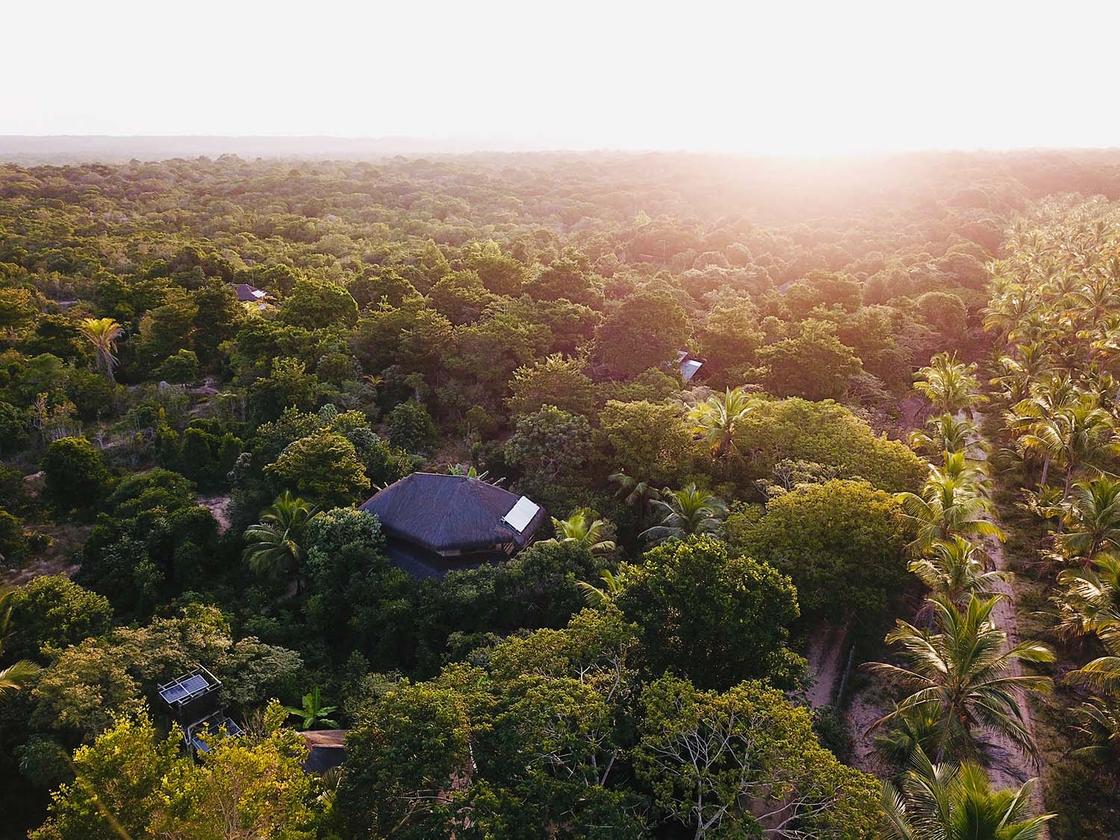
A Living Laboratory: Ecovila Piracanga 🇧🇷
One inspiring example is Ecovila Piracanga in Brazil — a coastal community integrating ecological sustainability with spiritual and personal development.
With 180 residents, including 40 children, Piracanga produces much of its own food using permaculture principles, builds with natural materials, runs holistic education programmes, and welcomes thousands of visitors annually.
Their experience within Weaving Resilience reflects what many communities discovered:
Resilience is not only about infrastructure — it’s about consciousness, culture, and the courage to transform.
Honest Reflections: Where Communities Struggle
The process also surfaced ongoing challenges:
-
Communication breakdowns
-
Governance inefficiencies
-
Power dynamics and rank
-
Participation fatigue
-
Unresolved conflicts
-
Overwhelm
These are not failures — they are the muscles of resilience being exercised.
As participants recognised:
"Personal and interpersonal resilience are built by continually choosing to tend to relationships"
Why This Course Matters Now
Research shows that a community’s ability to express emotion collectively and provide mutual support during crisis strongly influences its ability to navigate future shocks.
Climate change and polycrisis are not abstract risks — they are lived realities.
Weaving Resilience offers:
-
A structured, research-backed resilience assessment
-
Emotional and relational capacity-building
-
Tools for mapping strengths and gaps
-
Peer-to-peer global learning
-
Practical workshop materials
-
A community of practice that grows solidarity across differences
It creates a container where science meets soul, and systems thinking meets embodied wisdom.
The tools and knowledge from this course can be applied to any workplace, project, family or other community. Just because the pilot was conducted with ecovillages, it doesn't mean you need to live in an ecovillage to gain benefit from the course. Nor are the materials and tools just designed for ecovillages.
Weaving Resilience offers you tested tools, global connection, and grounded pathways forward.
As one participant reflected:
“When you look in detail at the situation of the world, the pain of the climate situation is strong. Yet we gain new power and hope when we have tools to visualise different futures.”
Resilience is not something we build alone.
It is something we weave — together.

0 comments
Leave a comment