

What Good Fire Teaches Us About Regeneration
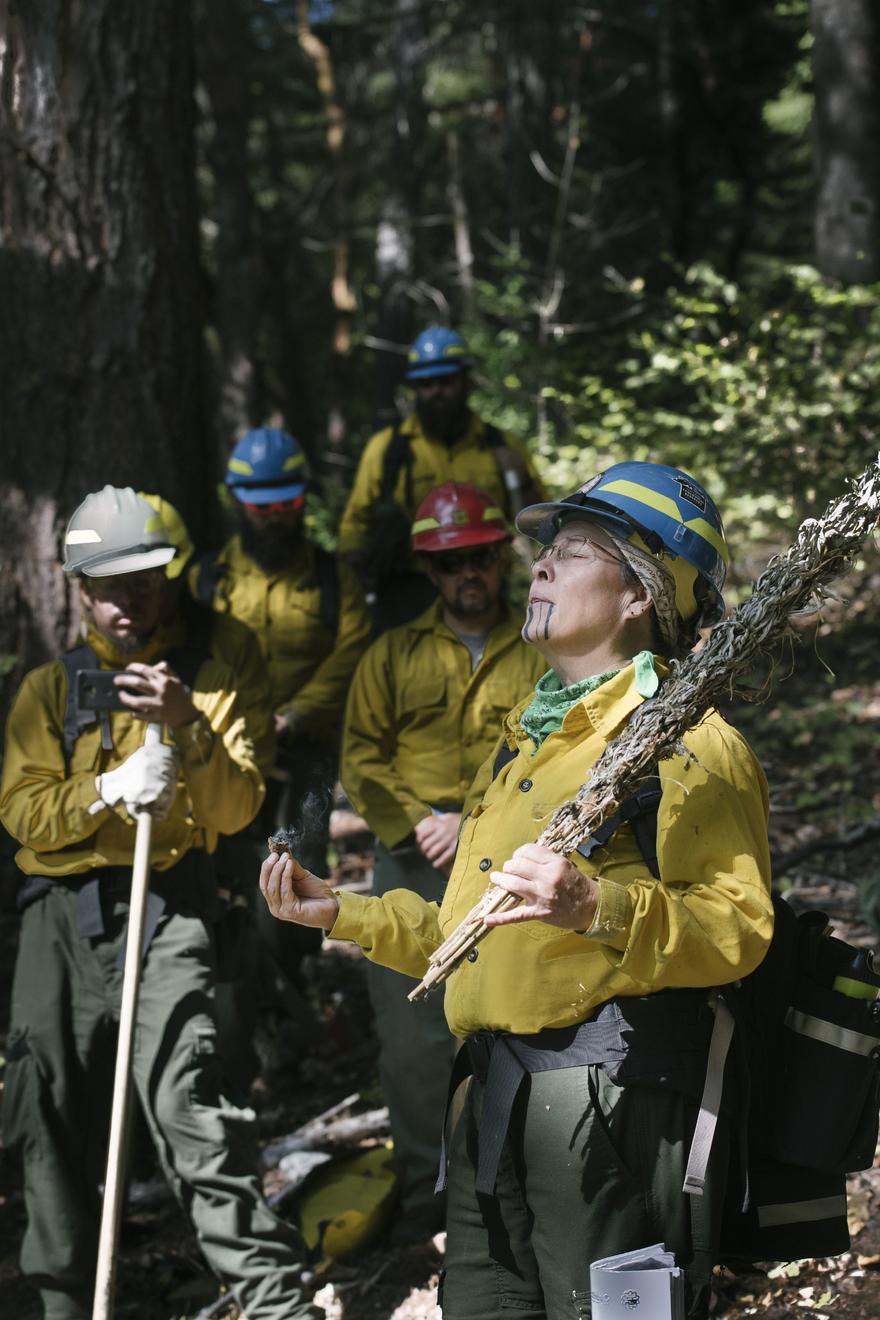
Image: Elizabeth Azzuz of the Cultural Fire Management Council opens a fire-training exchange, or TREX, on Yurok lands in 2019. She holds angelica root and wormwood, which are used to light a first, ceremonial fire. © Kiliii Yuyan
Most of us were told that fire was the enemy. A bear in a ranger hat said it plainly: only you can prevent forest fires. A century of fire suppression followed that logic across North America. Keep the flames out, and the land will be safe.
It turns out the opposite is closer to the truth. Many landscapes need to burn the way a body needs its blood to move. Good fire clears the old growth that chokes a forest, returns nutrients to the soil, and opens the pathways animals travel. Suppress it for a hundred years and you do not get safety. You get fuel piling up, circulation blocked, a system going quietly necrotic until it burns all at once.
Reclaiming the Good Fire
Curtis Ogden, who teaches our Energy Systems course, has worked with the Indigenous Peoples Burning Network and the Fire Learning Network, where tribes across the country are reclaiming the cultural burning their ancestors carried for generations. Much of this work is led by women. In Northern California, Curtis works alongside Elizabeth Azuz and Margo Robbins, both Yurok, who have spent years restoring fire to land that was told to fear it.
What they are doing is not firefighting. It is tending. They read the land, choose the moment, and set a fire that moves through it gently, leaving it healthier than before. The knowledge was nearly lost. Suppression was ecological policy, but it was also part of a longer effort to cut Indigenous peoples off from their own practices. To put fire back in those hands is to restore a flow that was deliberately severed.
Tulelake
Last November, Curtis sat in a gathering in Tulelake. Fifty or sixty people had come from tribes across the country to learn from one another about bringing fire home. Some of them wept. More than one person said the same thing: I didn't know this was happening. They had carried the loss so long that the simple fact of others doing this work undid them.
At one point an elder named Benny put a hand on Curtis's back and said quietly, "Healing is happening here." It is a sentence worth sitting with. Benny did not say progress, or restoration. He said healing. Grief was moving through that room, and grief moving is its own kind of regenerative flow. The network is now doubling the number of tribes asking for their fire back.
An elder named Benny put a hand on Curtis Ogden's back and said quietly, "Healing is happening here."
The Four Pillars, Visible in a Single Network
Looked at through the lens of energy systems, this work shows all four of the patterns that healthy living systems share.
There is regenerative flow: the literal fire returning to the land, the knowledge moving between tribes, the grief moving through people who had held it alone. There are balanced and resilient structures, with small local fire crews and emerging regional hubs forming the kind of fractal shape you find in a river delta or a branching tree. There is common cause culture, the shared conviction underneath every convening that we are in this together and we act like it. And there is collective learning, a codified journey where practitioners teach and mentor one another, elders and younger people side by side.
None of this was designed on a whiteboard. It grew. But the patterns are unmistakable once you know to look for them. A network map would show you the connections. What it would miss is everything actually moving through them.
Learning to See It
Energy, in the way Curtis uses the word, is whatever flow is crucial to the long-term vitality of a system. Sometimes it is obvious, like fire or nutrients or money. Sometimes it is subtle, like trust, or attention, or the grief that finally finds room to move. The health of a forest, a community, or an economy depends on what travels through the connections between its parts, and whether it reaches everyone or pools in a few places.
As Curtis puts it, Tulelake teaches you that you can read a community the way these fire-keepers read the land. You learn where circulation is blocked, where the structure has gone top-heavy, where trust has worn thin. And you learn that the most important flows are often the ones we were trained not to see.
If you want to learn to perceive systems this way, to feel the energy moving through the places and communities you care about, that is the heart of what we do together in this course. The next cohort begins on 28 September. We would be glad to have you in the room.

0 comments
Leave a comment